China Best Capacitors Inductors and Resistors Suppliers
Choosing China’s best capacitors inductors and resistors suppliers requires more than comparing prices or browsing polished websites. Reliable sourcing depends on verified specifications, stable production, responsive communication, and consistent quality control. Engineers and purchasing teams should examine each supplier’s product range, factory capabilities, testing methods, and experience with similar applications.
A dependable supplier can provide clear datasheets, tolerance details, temperature ratings, material information, and traceable batch records. These details matter when components enter power supplies, automotive electronics, industrial controls, or communication equipment. Practical experience also reveals small but important signals, such as careful packaging, accurate labeling, and quick answers to technical questions. A serious manufacturer should explain how incoming materials are inspected and how finished components are tested.
No supplier is perfect. A strong catalog may include limited customization, longer lead times, or uneven communication during peak seasons. That matters. Buyers should request samples, compare test results, review certifications, and confirm production capacity before placing large orders. Independent audits and realistic delivery records can strengthen confidence, but they should not replace technical verification.
This guide introduces leading Chinese manufacturers of capacitors, inductors, and resistors through a practical sourcing perspective. It considers product quality, engineering support, manufacturing experience, compliance awareness, and long-term reliability. Some information may change as factories expand or markets shift. Therefore, readers should treat this overview as a starting point, not a final decision. Careful evaluation remains essential.
Capacitors, Inductors and Resistors: Key Ratings from pF to 1000 μF
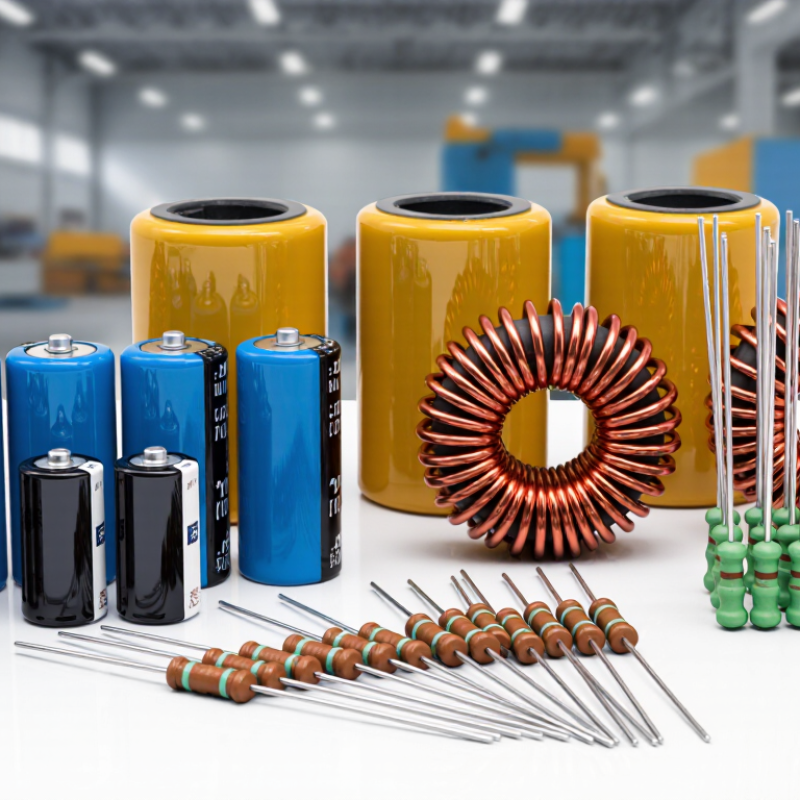
Choosing China’s best capacitors, inductors, and resistors suppliers requires more than comparing prices. The real test is whether ratings remain stable in working conditions. Capacitors may range from a few pF for radio-frequency tuning to 1000 μF for power smoothing. Check capacitance tolerance, rated voltage, leakage current, ESR, and temperature limits. A 1000 μF capacitor can lose effective capacity under ripple and heat.
Inductors need equally careful inspection. Review inductance, saturation current, RMS current, DC resistance, and self-resonant frequency. A compact power inductor may look suitable, yet its inductance can collapse near the saturation point. Resistors are usually specified by resistance, tolerance, power rating, voltage limit, and temperature coefficient. A 0.25 W resistor may need derating inside a warm enclosure. Small details matter.
Ask suppliers for current datasheets, test conditions, sample records, and lot traceability. Independent testing can verify capacitance, ESR, inductance, resistance, and thermal drift. I have seen clean specifications fail when measurements used different frequencies or temperatures. That gap deserves attention. Samples should be tested in the actual circuit, not only on a bench. Supplier evaluations should also check packaging, moisture protection, lead quality, and production consistency. Cheap components are not always economical. Sometimes, I still overestimate a datasheet’s clarity.
China Best Capacitors, Inductors and Resistors Suppliers
Capacitors, Inductors and Resistors: Key Ratings from pF to 1000 μF
The chart shows representative capacitance ranges for common capacitor technologies on a logarithmic scale. Ceramic capacitors are commonly selected for pF-to-μF filtering and decoupling, while tantalum and aluminum electrolytic capacitors extend into the hundreds or thousands of μF. Inductors are typically rated in μH or mH, and resistors in Ω, kΩ, or MΩ; actual ratings depend on voltage, current, tolerance, temperature, ripple current, and operating frequency.
China’s Passive Component Supply Chain: MLCC, Ferrite and Thick-Film Clusters
China Best Capacitors Inductors and Resistors Suppliers
China’s passive component supply chain is built around specialized regional clusters. MLCC production is concentrated near Guangdong, Jiangsu, and Zhejiang, where ceramic processing, printing, sintering, and automated inspection operate close together. A 2024 Fortune Business Insights report estimates the global MLCC market will grow from roughly US$13 billion in 2024, driven by electric vehicles, 5G equipment, and data centers. This demand is changing supplier selection. Capacity matters, but process stability matters more.
Ferrite manufacturers benefit from mature magnetic-material networks and nearby molding facilities. Thick-film resistor producers often combine screen printing, laser trimming, and resistance testing in compact factories. Mordor Intelligence forecasts continued growth in the global resistor market through 2029, with automotive and industrial electronics among the strongest applications. In practice, a clean production floor is useful evidence. It is not proof. A supplier may pass a sample test yet fail after six months of humidity exposure. My own purchasing checks would include lot traceability, X-ray or cross-section analysis, thermal cycling, and documented failure rates. The supply map is efficient, but not perfect.
Tips: Request three recent lot records, not one. Confirm tolerance after soldering. Check whether test equipment is calibrated. Ask for ISO 9001 or IATF 16949 evidence when automotive reliability is required. A low quotation can hide weak packaging, uneven plating, or long-term storage risk.
Supplier Evaluation by IEC 60384, IEC 60115 and ISO 9001 Compliance
China Best Capacitors, Inductors and Resistors Suppliers
Supplier evaluation should begin with evidence, not catalog thickness.
IEC 60384 testing supports capacitor assessment for capacitance, voltage, endurance, and insulation behavior. IEC 60115 addresses fixed resistors, including resistance stability and climatic performance. For inductors, buyers should request the applicable product standard and test method. A supplier using the wrong standard creates hidden risk.
ISO 9001 certification shows that a quality management system exists.
It does not automatically prove every component is reliable. Check the certificate scope, audit date, production site, and corrective-action records. Request lot-level data, including temperature cycling, dielectric strength, resistance drift, and inductance tolerance. A sample report should show test equipment, calibration status, operators, and acceptance limits. Small details matter.
Industry demand is also substantial.
A 2024 passive electronic components market assessment estimated the global market above 35 billion US dollars, with automotive, industrial, and telecommunications applications driving growth. The 2024 World Semiconductor Trade Statistics forecast continued electronic-system expansion, increasing pressure on stable component supply. Yet market growth can encourage rushed qualification. A polished factory tour proves little. Suppliers should provide traceable material records and retained samples for independent testing. Certificates can be outdated. Testing can be incomplete. Even this evaluation method is not perfect, because laboratory performance may change under real vibration, humidity, and assembly stress.
Comparing Capacitance, Inductance, Resistance, Tolerance and DCR Data
When comparing capacitor, inductor, and resistor suppliers in China, datasheet consistency matters more than a polished catalog. I check capacitance, inductance, and resistance under stated test conditions. A 10 µF capacitor may be measured at 1 kHz, while its capacitance changes sharply under voltage bias. Inductance can also shift under current. Test conditions matter. Ask for sample reports, drawings, and lot traceability before approving production.
Tolerance shows how closely a component meets its nominal value. A 1% resistor is not automatically better than a 5% part. Temperature, power rating, and circuit sensitivity decide that choice. For inductors, saturation current and core loss belong beside inductance data. For capacitors, ESR, leakage current, and rated voltage deserve equal attention. I prefer suppliers that explain test methods clearly, rather than offering only impressive ranges.
DCR is especially practical when selecting power inductors. Excessive DCR creates heat, reduces efficiency, and may change the thermal design. Measure it with a four-wire method when resistance is very low. Lead resistance can distort results. My review process is not perfect; early samples sometimes pass electrical checks but fail mechanical fitting. That mistake taught me to compare drawings, samples, and inspection records together. A reliable supplier should document deviations before shipment.